McBride Kelly Real Estate News & Advice

Buying a home is likely to be the largest purchase you make in your lifetime.  Helping you every step of the way is our job and we will perform it as efficiently and effectively as possible.  Our blog is intended to provide you with as much helpful background information and advice as possible.  Please reach out if you have any questions at all. We would love to talk with you!

Jan. 21, 2022

Americans Choose Real Estate as the Best Investment

Americans Choose Real Estate as the Best Investment [INFOGRAPHIC] | MyKCM

Some Highlights

  • According to a Gallup poll, real estate has been rated the best long-term investment for eight years in a row.
  • Real estate tops the list because you’re not just buying a place to call home – you’re investing in your future. Real estate is typically considered a stable and secure asset that can grow in value over time.
  • Let’s connect today if you’re ready to make real estate your best investment this year.
Posted in Market Updates
Jan. 21, 2022

Buyers Want To Know: Why Is Housing Supply Still So Low?

Buyers Want To Know: Why Is Housing Supply Still So Low? | MyKCM

One key question that’s top of mind for homebuyers this year is: why is it so hard to find a house to buy? The truth is, we’re in the ultimate sellers’ market, so real estate is ultra-competitive for buyers right now. The number of buyers searching for a home greatly outweighs how many homes are available for sale.

While low inventory in the housing market isn’t new, it’s a challenge that continues to grow over time. Here’s a look at two reasons why today’s housing supply is low and what that means for you.

1. New Home Construction Fell Behind for Several Years

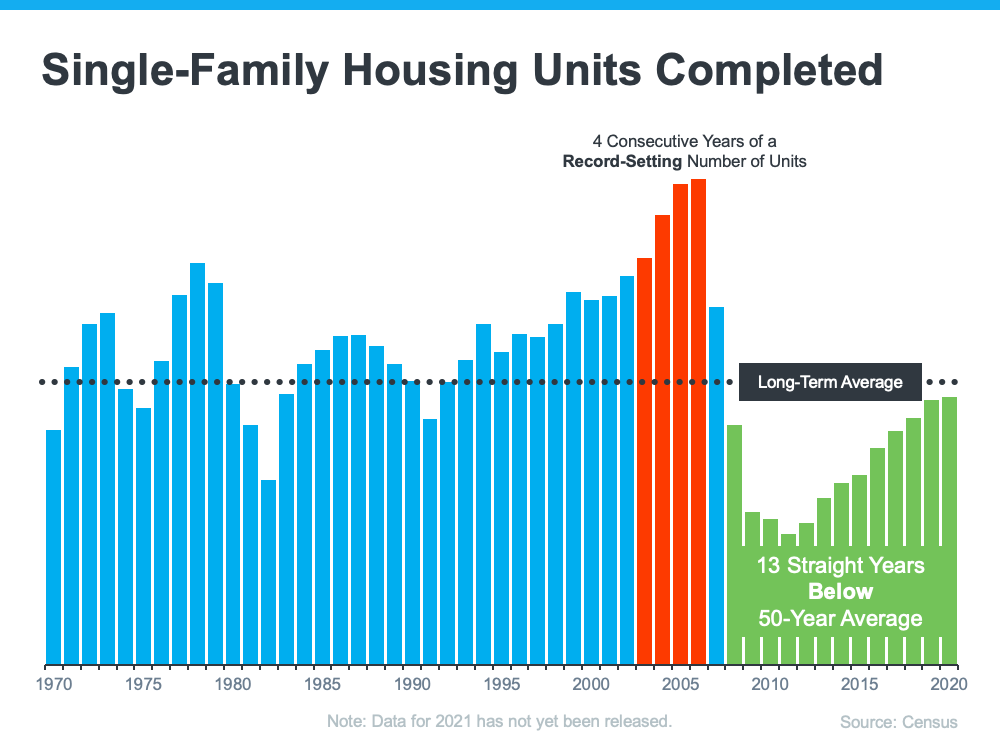
The graph below shows new home construction for single-family homes over the past five decades, including the long-term average for housing units completed. Builders exceeded that average during the housing bubble (shown in red on the graph). The result was an oversupply of homes on the market, so home values declined. That was one of the factors that led to the housing crash back in 2008.

Since then, the level of new home construction has fallen off. For the last 13 straight years, builders haven’t been able to construct enough homes to meet the historical average (as illustrated in green on the graph). That underbuilding left us with a multi-year inventory deficit going into the pandemic.

Buyers Want To Know: Why Is Housing Supply Still So Low? | MyKCM

2. The Pandemic’s Impact on the Housing Market

Then, when the pandemic hit, it fueled a renewed appreciation and focus on the meaning of home. Having a safe space to live, work, school, and exercise became even more important for Americans throughout the country. So, as mortgage rates dropped to at or below 3%, buyers eagerly entered the market looking to capitalize on those low rates to secure a home that would fulfill their changing needs. At the same time, sellers hesitated to put their houses on the market as concerns about the pandemic mounted.

The result? The number of homes available for sale dropped even further. A recent article from realtor.com explains:

Last month, the number of home listings dropped 26.8% compared with the same time a year earlier. This meant there were about 177,000 fewer homes listed in what’s already typically a slower month due to the holidays and colder weather. . . .”

What Does All of This Mean for You?

For a buyer, low inventory can be a challenge. You want to find the home of your dreams, and you don’t want to settle. But what if there just aren’t that many homes to choose from?

There is some good news. Experts are projecting more homes will soon become available thanks to sellers re-entering the market. Danielle Hale, Chief Economist at realtor.com, shares this hope, but offers perspective:

We expect that we’ll start to see a turnaround and inventory will stabilize and start to go up a little bit in 2022. . . . But that means we’re looking at inventory levels of roughly half of what we saw before the pandemic. For buyers, the market is likely to continue to move fast. If you see a home you like, you want to jump on it right away.

Basically, inventory is still low, even though more homes are coming. But you shouldn’t put your plans on hold because you’re waiting for those additional houses to hit the market.  Instead, stick with your search and persevere through today’s low inventory. You can find your next home if you’re patient and focused.

Remember your goals and why finding a home is so important. Those things should be the driving force behind your search. Share them with your agent and be clear about your priorities. Your trusted advisor is your greatest support as you navigate today’s low housing supply to find the home of your dreams.

Bottom Line 

If you’re planning to buy this year, the key to success will be patience given today’s low inventory. Let’s connect to discuss what’s happening in our area, what homes are available, and why it’s still worthwhile to prioritize your home search today.

Posted in Market Updates
Jan. 21, 2022

With Mortgage Rates Climbing, Now’s the Time To Act

With Mortgage Rates Climbing, Now’s the Time To Act | MyKCM

Last week, the average 30-year fixed mortgage rate from Freddie Mac jumped from 3.22% to 3.45%. That’s the highest point it’s been in almost two years. If you’re thinking about buying a home, this news may have come as a bit of a shock. But the truth is, it wasn’t entirely unexpected. Experts have been calling for rates to rise in their 2022 projections, and the forecast is now becoming a reality. Here’s a look at the projections from Freddie Mac for this year:

View More
Posted in Home Buying Tips
Jan. 21, 2022

Achieving the Dream of Homeownership

Achieving the Dream of Homeownership | MyKCM

Homeownership has long been considered the American Dream, and it’s one every American should feel confident and powerful pursuing. But owning a home is also a deeply personal dream. Our home provides us with safety and security, and it’s a place where we can grow and flourish.

View More
Posted in Home Buying Tips
Jan. 14, 2022

What’s Going To Happen with Home Prices This Year?

What’s Going To Happen with Home Prices This Year? | MyKCM

After almost two years of double-digit increases, many experts thought home price appreciation would decelerate or happen at a slower pace in the last quarter of 2021. However, the latest Home Price Insights Report from CoreLogic indicates while prices may have plateaued, appreciation has definitely not slowed. The following graph shows year-over-year appreciation throughout 2021. December data has not yet been released.

View More
Posted in Market Updates
Jan. 14, 2022

Two Ways Homebuyers Can Win in Today’s Market

Two Ways Homebuyers Can Win in Today’s Market | MyKCM

If your goal is to purchase a home this year, you might be looking for any advantage you can get in today’s sellers’ market. While competition is still fierce for homebuyers, there are ways you can win and secure the home of your dreams, even in a hot market.

View More
Posted in Home Buying Tips
Jan. 14, 2022

Why Inflation Shouldn’t Stop You from Buying a Home in 2022

Why Inflation Shouldn’t Stop You from Buying a Home in 2022 | MyKCM

If you’re following along with the news today, you’re probably hearing a lot about record-breaking home prices, rising consumer costs, supply chain constraints, and more. And if you’re thinking about purchasing a home this year, all of these inflationary concerns are likely making you wonder if you should wait to buy. Investopedia explains that during a period of high inflation, prices rise across the board. And while home prices aren’t immune from this increase, here’s why inflation shouldn’t stop you from buying a home in 2022.

View More
Posted in Home Buying Tips
Jan. 14, 2022

Real Estate Professionals Are Experts at Keeping You Safe When You Sell

Real Estate Professionals Are Experts at Keeping You Safe When You Sell | MyKCM

If you’re on the fence about whether or not you want to sell your house this year, there’s good news. For nearly two years, real estate professionals have worked tirelessly to ensure the safety of buyers and sellers during the pandemic.

View More
Posted in McBride Kelly
Jan. 8, 2022

How To Hit Your Homebuying Goals This Year

How To Hit Your Homebuying Goals This Year [INFOGRAPHIC] | MyKCM

Some Highlights

  • If you’re looking to buy a home, you may want to put these items on your to-do list to ensure you hit your goals.
  • It’s important to start working on your credit and saving for a down payment early. When you’re ready to begin your search, work with a real estate professional and get pre-approved so you know how much you can borrow.
  • Connect with a real estate advisor so you have the guidance you need to achieve your homebuying goals this year.
Posted in Home Buying Tips
Jan. 8, 2022

There Won’t Be a Wave of Foreclosures in the Housing Market

There Won’t Be a Wave of Foreclosures in the Housing Market | MyKCM

When mortgage forbearance plans were first announced and the pandemic surged through the country in early 2020, many homeowners were allowed to pause their mortgage payments. Some analysts were concerned that once the forbearance program ended, the housing market would experience a wave of foreclosures like what happened after the housing bubble 15 years ago.

Here’s a look at why that isn’t the case.

1. There Are Fewer Homeowners in Trouble This Time

After the last housing crash, over nine million households lost their homes to a foreclosure, short sale, or because they gave it back to the bank. Many believed millions of homeowners would face the same fate again this time.

However, today’s data shows that most homeowners exited their forbearance plan either fully caught up on payments or with a plan from the bank that restructured their loan in a way that allowed them to start making payments again. The latest data from the Mortgage Bankers Association (MBA) studies how people exited the forbearance program from June 2020 to November 2021.

Here are those findings:

38.6% left the program paid in full
  • 19.9% made their monthly payments during the forbearance period
  • 11.8% made up all past-due payments
  • 6.9% paid off the loan in full
44% negotiated work-out repayment plans
  • 29.1% received a loan deferral
  • 14.1% received a loan modification
  • 0.8% arranged a different repayment plan
0.6% sold as a short sale or did a deed-in-lieu
16.8% left the program still in trouble and without a loss mitigation plan in place

2. Those Left in the Program Can Still Negotiate a Repayment Plan

As of last Friday, the total number of mortgages still in forbearance stood at 890,000. Those who remain in forbearance still have the chance to work out a suitable plan with the servicing company that represents their lender. And the servicing companies are under pressure to do just that by both federal and state agencies.

Rick Sharga, Executive Vice President at RealtyTrac, says in a recent tweet:

“The [Consumer Financial Protection Bureau] and state [Attorneys General] look like they're adopting a ‘zero tolerance’ approach to mortgage servicing enforcement. Likely that this will limit #foreclosure activity for a good part of 2022, while servicers explore all possible loss [mitigation] options.”

For more information, read the warning issued by the Attorney General of New York State.

3. Most Homeowners Have More Than Enough Equity To Sell Their Homes

For those who can’t negotiate a solution and the 16.8% who left the forbearance program without a work-out, many will have enough equity to sell their homes and leave the closing with cash instead of facing foreclosures.

Due to rapidly rising home prices over the last two years, the average homeowner has gained record amounts of equity in their home. As Frank Martell, President & CEO of CoreLogic, explains:

“Not only have equity gains helped homeowners more seamlessly transition out of forbearance and avoid a distressed sale, but they’ve also enabled many to continue building their wealth.”

4. There Have Been Far Fewer Foreclosures Over the Last Two Years

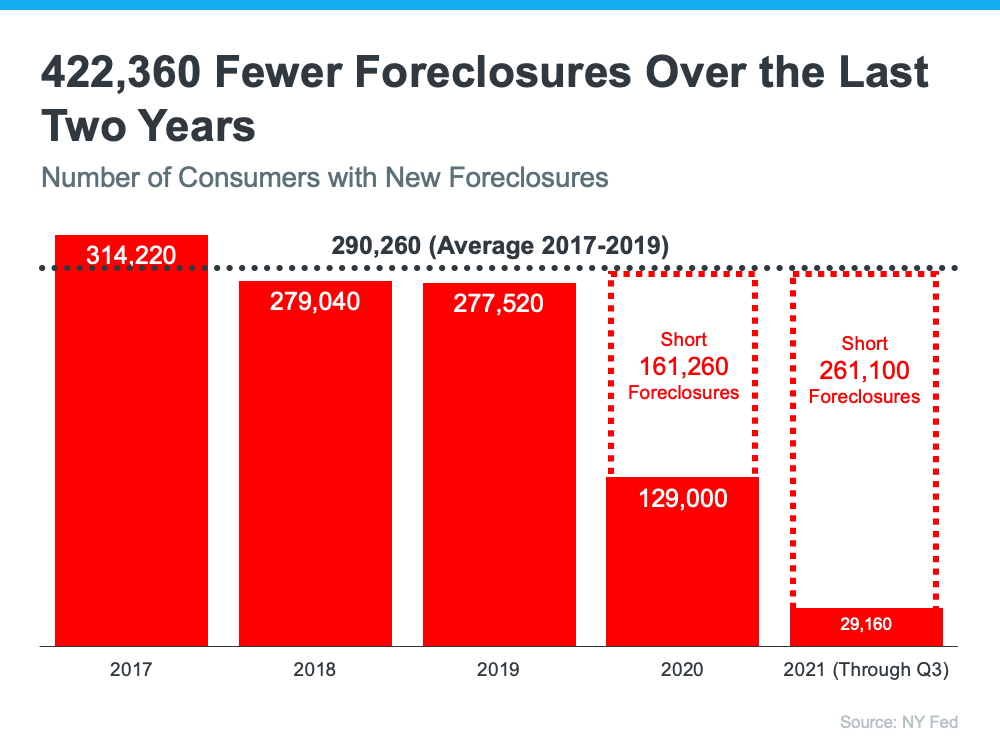
One of the seldom-reported benefits of the forbearance program was that it allowed households experiencing financial difficulties prior to the pandemic to enter the program. It gave those homeowners an extra two years to get their finances in order and work out a plan with their lender. That prevented over 400,000 foreclosures that normally would have come to the market had the new forbearance program not been available. Otherwise, the real estate market would have had to absorb those foreclosures. Here’s a graph depicting this data:
There Won’t Be a Wave of Foreclosures in the Housing Market | MyKCM

5. The Current Market Can Easily Absorb Over a Million New Listings

When foreclosures hit the market in 2008, they added to the oversupply of houses that were already for sale. That resulted in over a nine-month supply of listings, and anything over a six-month supply can cause prices to depreciate.

It’s exactly the opposite today. The latest Existing Home Sales Report from the National Association of Realtors (NAR) reveals:

“Total housing inventory at the end of November amounted to 1.11 million units, down 9.8% from October and down 13.3% from one year ago (1.28 million). Unsold inventory sits at a 2.1-month supply at the current sales pace, a decline from both the prior month and from one year ago.”

A balanced market would have approximately a six-month supply of inventory. At 2.1 months, the market is severely understocked. Even if one million homes enter the market, there still won’t be enough inventory to meet the current demand.

Bottom Line

The end of the forbearance plan will not cause any upheaval in the housing market. Sharga puts it best:

“The fact that foreclosure starts declined despite hundreds of thousands of borrowers exiting the CARES Act mortgage forbearance program over the last few months is very encouraging. It suggests that the ‘forbearance equals foreclosure’ narrative was incorrect. . . .”

Posted in Market Updates